Sunday, November 25, 2012

Bike Like An Entrepreneur

 Assuming you know how to bike, can you imagine learning to do so by reading some books, watching some movies, and listening to a bunch of lectures by some of the most prominent bikers of the time? Exactly! You cannot learn how to bike unless you jump on a bike with some training wheels and then over time start taking off those training wheels.

The same is true of entrepreneurship. Entrepreneurship is a skill, and skills are acquired through practice. There is simply no shortcut around it. Desiring a shortcut, in fact, would mean you are missing the whole point. It is like wanting to know how to ride a bike without having to ride a bike.

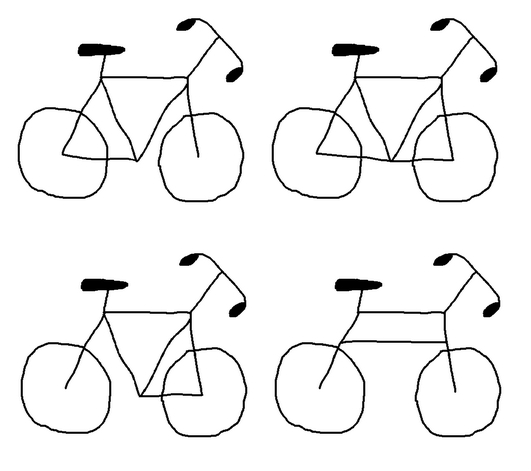
And for those of you who already know how to ride a bike, don't be overconfident about your skills. There is still a lot all of us can learn as the below psychology experiment which I just failed demonstrates (excerpt and photos are from May 9, 2012 YANSS Blog):

Take a look at those bicycles at the top of this post. Which one would you say is the most accurate portrayal of a real bike? Psychologist Rebecca Lawson once put together a study that revealed even though most people are very familiar with bicycles and know how to ride them, they can’t draw one to save their lives, and they can’t even pick a proper one out of a lineup. Despite this, most people rate their knowledge of how a bicycle works as being very good. Remember that when someone claims to understand something a bit more complicated, like a sub-prime mortgage. (This is a picture of a real bicycle.)


Sunday, November 11, 2012

Which is Better: Greed or Vision?


Is greed "good" when it comes to high tech startups? A protracted twitter exchange with fellow entrepreneur Jason Tryfon this morning made me realize that it is time to put in writing a more detailed defense of what I have been preaching in the Valley for some time:

It is my belief that startup founders who prioritize financial rewards over a specific vision/mission are less likely to succeed/survive compared with visionary founders.

I have seen many knee-jerk reactions to my above position. Here are some of my favorites:

(1) Accounting 101: A business cannot survive without money. Therefore, the quest to generate cash and ultimately profits should be the most important pursuit for a startup and everything else would be of less importance.

(2) HR 101: A startup needs talent to innovate and survive. Without promise of great financial rewards, a startup cannot recruit and retain requisite talent to really make it in a competitive labor market.

(3) Economics 101: As Adam Smith pointed out, all you need for a well-functioning free market is rational, profit maximizing individuals and firms. As long as people/firms engage in profit maximizing endeavors, the society benefits and progress is made. As a corollary, then, pursuing anything else is sub-optimal and is bad for society.

(4) Psychology 101: There is no better incentive than money to motivate behaviour, because money is quantifiable and can be used to obtain other things that individuals may idiosyncratically value. Therefore, the promise of great financial rewards is what makes a company innovate and succeed.

(5) Business Law 101: The founders/board/management of a company owe a fiduciary duty to their shareholders to maximize their return on investment. Therefore, prioritizing any other goal would be a violation of their fiduciary duty and grounds for shareholder lawsuits.

All of these arguments, however, either lack empirical, real-world support, or are actually compatible with my assertion about the vision-driven startups. So, let's take them one by one:

(1) My Reply to Business 101: A business cannot survive without many things. Cash is of course one such thing. So is motivated employees. But even if cash was the only thing without which a business could not survive, it does not logically follow that businesses ought to make profits their primary objective. Take for instance the statement that "A person cannot survive without air." Does it follow then a person ought to make pursuit of air their primary objective in life? Just because something is necessary for survival, it doesn't follow that its pursuit ought to be the objective of life. It is relatively easy to see that in case of human beings, higher goals and objectives are things that make life (and its necessary attributes such as breathing and eating) well worth it, but some of us lose that perspective when dealing with businesses for some reason. A business needs to make money to accomplish its goals, just as a person needs to stay healthy, eat, breathe air, etc. to accomplish its goals.

(2) My Reply to HR 101: I have been a witness to how non-financial rewards play a significant role in recruiting. I have recruited employees away from other startups because of differentiated vision or working conditions, and at many times, people have been willing to take a pay-cut. I have yet to see a single employee for whom the actual dollar value of results was the only factor in their career decisions. (Continued under Psychology 101 below)

(3) My Reply to Economics 101: News flash for Adam Smith followers: Turns out, based on a number of ongoing studies in econ and psych departments worldwide, people are not purely rational, selfish, profit-maximizing agents! People's sense of morality, fairness, empathy, altruism, and other cultural influences significantly inform and impact our decisions. There is even an emerging interdisciplinary field, called neuroeconomics, that is trying to make sense of all the irrational choices people make in their lives. Bottom line, there is too much unknown about human psyche and motivation to make any kind of normative judgment about how markets function. Furthermore, if the primary purpose of all firms in the market was to maximize profits, wouldn't the market ultimately converge on one firm that had figured out how to maximize profits? On the other hand, there are probably as many visions for the future as there are people in the world. Wouldn't the society benefit more if people focused on how to realize their vision?

(4) My Reply to Psychology 101: Although I don't dispute that money is a motivator, I do think its motivational influence is seriously hyped. Throughout history, tens of millions (at least) have been willing to put their lives in jeopardy or even willingly welcomed death in pursuit of their religious, philosophical or social beliefs. How many have done so for greed? In today's transparent labor market where compensations have pretty much converged amongst startups around the same stage, what startups compete on is their vision and sense of purpose. And in my opinion, when the going gets tough, those emplyees who are their for the vision are the ones who are willing to make "irrational" sacrifices (take pay cuts, work longer than legally or medically sanctioned hours) to see the dream come true.

(5) My Reply to Business Law 101: Maximizing shareholder value is not incompatible with giving priority to the vision of the company. This is assuming that the vision was articulated at the time of fundraising. The vision provides the boundary conditions within which the shareholder-value-maximizing activities are to take place. In fact, if the company decides to change course/vision/industry without approval from shareholders, that can land the Board/management team in as much legal trouble when things go south.

Bottom line, you gotta make money, but that doesn't mean you have to give up your dreams (or soul) to do so!


Wednesday, October 31, 2012

Why We Dislike Facebook Ads - Or, The Quest To Preserve Our Free Will

Let's face it, there is something philosophically unsettling about ads on Facebook (or any other online property in possession of interest graph data about us).  What makes those ads so appealing is exactly what makes it so offensive to click on them. Here is an illustrative example:

This morning when I was staring at some display ads on Facebook, I could hear myself think "How dare they tell me what I should be clicking on by looking at my profile and activities on the site? Am I not more than a mere formula derived from my Likes, Interests and Comments? They think they have figured me out, but I will show them [and went on to click on a photo rather than an ad]"

And therein lies the dilemma for Facebook. Their ads are only relevant to us, by definition, if they appeal to our interests. But if and when they do truly appeal to our interests, they alienate us by confronting us with the age-old philosophical problem about free will vs. determinism, i.e., the question as to whether or not we are truly in charge of our own actions or whether we are just some sophisticated automaton running a super-fancy script in the background. And when our intuitions about our own free agency get rubbed the wrong way, we react the only way we know how to react, namely by doing the exact opposite of what our manipulators want us to do. That is, we ignore the ads!

The fact of the matter is, however, that manipulation (in its most non-judgmental sense) has become the way of doing business online. All consumer Internet companies are based on running A/B tests that are geared to funnel our online behavior towards the goals of various products, applications and advertisers. And surprisingly, we have a high tolerance for much of that manipulation. We dislike the implied manipulation of ads (unless they are tied to our intentions via search engines), but welcome music recommendations made by Pandora, job recommendations made by LinkedIn or a myriad of other online services that we use on a daily basis, all of which tap into our interest graph and other behavioral data to predict what we like. So, why the discrepancy?

The only way I can make sense of our conflicting intuitions is that in certain circumstances (let's call them "benign manipulations") our sense of free will does not get violated and in others (let's call them "commercial manipulations"), it does. According to some of the leading compatibilist philosophers such as Daniel Dennett (those believing that we can have free will in a deterministic world), our ability to veto manipulations and control what our desires dictate is what gives us the sense of our free will, giving us "the kind of free will worth wanting". Therefore, we don't feel compelled to veto benign manipulations because we feel that upon reflection they are genuinely in our own interests, whereas commercial manipulations compel us to veto them because we suspect they are not truly in our interests. Those commercial manipulations invoke the image of a car salesman, except one that has also peeked inside our brain.

I don't have a prescription for what Facebook shall do with its ads to make them compatible with my sense of free will, but I am glad that I can still have my free will and browse the web.


Saturday, January 21, 2012

An Ode to the Valley

I loved reading Justin Rosenstein's inspirational, heart-felt post Do Great Things on TechCrunch this week. It talks to the same "Death of Big Ideas" phenomenon I blogged about after visiting SXSW Conference last year, and makes a powerful case for why the pursuit of Big Ideas by us, the privileged members of the Valley tech community, is a moral imperative.

You must read Justin's piece in its entirety, but as a preview here are some of my favorite quotations from it:
Technology, community, and capitalism combine to make Silicon Valley the potential epicenter of vast positive change. 


And with increasingly severe threats to our survival — rapid climate change, an unstable international economy, and unsustainable energy consumption — it is more important than ever that we... change the world, foster happiness and alleviate suffering, for us and our fellow beings.

[I]n the face of threats to humanity’s future on the one hand and the extraordinary potential of mankind on the other, at some point we must ask: are we capable of more?

Life is short, youth is finite, and opportunities endless. Have you found the intersection of your passion and the potential for world-shaping positive impact? 

Don’t lose the fire you started with. If you’re going to devote the best years of your life to your work, have enough love for yourself and the world around you to work on something that matters to you deeply... in order to do great things, we must attempt great things.


Why Are Kids Losing Interest in Entrepreneurship?

As you can judge by its title, this Forbes article posted more than 2 months ago is quite troubling: Kids Lose Interest in Entrepreneurship as They Get Older. In this article, Forbes peeled back the onion on an otherwise rosy 2011 Gallup poll on entrepreneurship to find that
While 65 percent of fifth and sixth graders plan to start a business, only 34 percent of high school kids do. (see graph below)
Thus, somehow as a country we lose 50% of our total entrepreneur population in middle school! And what troubles me even more is the lack of any substantive or serious discussion on this (critical) topic by any politician or educators.

What is amiss?

The Forbes article takes a stab at a response:
For insight into why older kids are less likely than younger ones to plan to start businesses, I turned to my resident expert on what kids think – my fourth grade daughter Hannah.  Hannah’s explanation was that kids learn about alternatives to an entrepreneurial career as they get older.  As kids become interested in other jobs, the share that plans to start a business declines.
But with all due respect to the author's fourth grade daughter, this does not seem to get at the heart of the issue. In my own childhood experience and that of most toddlers, the various white collar and blue collar professions are the first "jobs" that kids get exposed to: Firefighter, Police, Doctor, Nurse, Mechanic, Pilot, Flight Attendant, Captain, Cashier, Factory Worker (especially if chocolate is involved), Factory Manager, Actor, Actress, Ballerina, Athlete, Teacher, etc. Instead, what I think is the culprit here is the fear of failure that a lot of educators instill in children that turns otherwise adventurous souls into scared puppies.

It has been a truism for a long time that small businesses and entrepreneurs are the engine of growth of our economy. Yet, it seems that somehow our primary education system systematically manages to kill the very engine of growth we are trying to fuel. What do you think? Can we do a course correction? Any and all solutions are welcome!


Thursday, January 12, 2012

It's the Semantics, Stupid!

A Matter of Semantics
 I have to take a deep breath whenever someone brushes aside an argument as one over mere "semantics", as if there is a "reality" out there unperturbed by our linguistic filters. After all, "Why argue over words?" goes the common adage! And although that kind of attitude may temporarily get us out of a heated argument and allow the parties to save face, cool off, and part amicably, it is completely counter-productive when it comes to making one of the most important decisions about your startup, which is formulating its strategic positioning.

Why Strategic Positioning Matters
Coming up with the right positioning for your startup is at least half the battle (if not most of it)! For one, I have been involved with several startups where a change in that elusive positioning statement was the single most important contributor to its ultimate success or demise.

If you think I am exaggerating, monitor your own gut reaction to the following positioning statements: "to help people find the most relevant websites for their search queries" versus "to organize the world's information and make it universally accessible and useful". Do you think Google would have been as successful in building a world-class team with the former statement, even though semantically they are basically referring to the same underlying algorithm (aka, PageRank)? Or would you feel the same about a company that aspires to be "the best website creation tool" versus one that aspires to be "the world's leading tool for small businesses to get online and grow their business", despite having the same technology? In fact, at Webs, where we made that exact change in our mission statement 18 months ago, we set in motion a positively reinforcing set of events that led to the successful exit of the company last month.

The Critical Role of Words
As the examples above illustrate, when it comes the positioning statement every word counts, as does the emotions they evoke individually and in combination with the other words in that statement. Choose those words carefully as each evokes a different mental state (e.g., "male sibling" evokes  very different feelings from "brother", despite referring to the same person).

Marketers are fully aware of this and spend endless hours on crafting the right slogan(s) and testing them against the audience. You can run your own experiments online by spending a few dollars on some Google ads and comparing variants of saying the same thing; can be quite fun!

When taken seriously, coming up with the right positioning statement by choosing the right set of words is not a trivial task; but once you get that single statement right you will see how much easier it is to recruit, raise money, motivate your team, and even set product development priorities.


Tuesday, November 01, 2011

Products "R" Features


As a freshly minted Associate at a venture capital firm in early 2000's, I recall that one of my criteria for evaluating investment opportunities was figuring out (with analytic precision, of course) whether a particular startup was really a "product" or a "feature"... Turns out that was a totally futile (if not counterproductive) exercise!

So many of today's über-successful startups in fact are nothing more than features. Google started out as a feature inside a portal (Yahoo) and who knows, may end up being a feature inside a social network or mobile device 5 or 10 years from now. And look at all these neat features on your smart phone called Apps! Wouldn't you have loved to invest in some of the popular ones, like Angry Birds?

I think the traditional problem with investing in "feature" companies is the concern that a "product" company in that industry, with its seemingly infinite resources, can one day easily roll out that feature and crush that "feature" company. Sort of like how Apple crushed (wink, wink, nudge, nudge) Siri to the tune of over $200 million and Google crushed YouTube for $1.7 billion...

Suffice it to say, lots of great VC investments can be made in things that may be considered mere features today, but will end up being far more revolutionary and game-changing than many products in the market.  In the long run, we will all be dead and all products become features anyway!

Beware of "Happy Talk"

Nothing scares me more than Happy Talk, even on Halloween. We've all had our encounters with it. You know Happy Talk as soon as you hear it. And it makes our skin crawl...


It usually starts with "Things are going great! Best times ever! Tons of traction! Gods are smiling upon us!" and ends on similar upbeat notes "Couldn't ask for more! Just tryin' to keep up!" You catch my drift... SPOOKY!

Now, I am all for enthusiasm, positivity, and faith even in the face of severest hardships. Every entrepreneur needs to have those elements as a part of their M.O. or sooner or later will give up entrepreneurship for at least a steady income (if not peace of mind). However, it is one thing to be positive, and completely another thing to lull yourself into thinking that things are positive by ignoring the negative.

The danger with Happy Talk is our mental predisposition towards what psychologists broadly label as cognitive dissonance, the tendency of our brains to interpret reality only in the way that fits our thoughts and attitudes about it. Confirmation bias is another name for it. There are literally thousands of experiments that support this point, and they are all actually quite fun to read. For example:
  • An Ohio State study in 2009 showed people spend 36% more time reading an essay if that essay aligns with their opinions.
  • Another study at Ohio State in 2009 showed subjects clips of “The Colbert Report,” and people who considered themselves politically conservative consistently reported “Colbert only pretends to be joking and genuinely meant what he said."
So, the same mental processes kick into gear once you engage in Happy Talk. You start drinking your own Cool Aid. You start ignoring all those little data points that don't fit the overall positive picture you are painting. And you know what happens after that...

So, next time you catch yourself engaging in such spooky activities, take a moment and reflect on whether your attitude really matches the data. That may save the day for you!

Happy Halloween!


Monday, October 10, 2011

Steve Jobs: The Founder Archetype


I started this post with a list of my top 10 favorite things about Steve Jobs, but soon realized that any such attempt is futile at best. As the Da Vinci of our time, Steve Jobs' accomplishments were not limited to a set of inventions, principles, or theories. They spanned multiple disciplines (comp sci and art, for example), multiple decades (starting with the 80's, remember the original Mac?), and will have far reaching implications into the future (wearable computing, for instance).

But the one thing that will make him forever immortal, IMHO, is the fact that he has established himself as the "Founder Archetype" for as long as entrepreneurship will exist. His passion, ambition, perseverance, dedication and determination will be that which all founders will be judged by and compared against. He has truly upped the game for all of us; and that maybe his greatest legacy!

P.S. For some inspiration on how others are preparing themselves for this challenge, you may want to read and follow #LiveLikeSteve

Sunday, October 02, 2011

Chamath's Golden Rule!

Starting with my first topical post on this blog, I have been praising the advantages of a high integrity culture as the foundation of a sustainable business. Yesterday's leaked email from investor Chamath Palihapitiya to Airbnb CEO, wherein he provides an eloquent reason for not wanting to participate in a financing round that does not pass his integrity test, is a great reminder to all founders and executives of the importance to stay vigilant about preserving a culture of integrity in their startups. I confess that I don't know much about Airbnb's culture, but based on some of their past notoriety in the press (see one thread on TechCrunch here), I can see how small, incremental compromises in integrity may have led to this point, and hopefully Chamath's email and the attention it has raised to this matter can be a turning point for the company.

Here is my favorite paragraph from Chamath's email, which provides solid practical advice on how to preserve integrity within your organization:
Treat your employees the same as you’d treat yourself. Do things that you will be proud of and can defend to anyone including your Board, employees, prospective hires etc. In such a competitive hiring market, you are competing with not just your obvious competitors, but also any successful tech company who is also looking for great talent. A principle that treats your employees as well as you’d treat yourself is a huge strategy for differentiation, retention and long term happiness of the exact types of people you will need to be successful. In contrast, if you are viewed as self-dealing and shady, it will only hurt your long term prospects…
The highlighted first sentence above is what I would like to call "Chamath's Golden Rule for Management", which is a great modern application of the ancient Golden Rule.

I recall that as I a lawyer I used to advise my clients against doing something they would hate to see on the cover of WSJ. Airbnb founders may find themselves in that uncomfortable position on Monday!

P.S. As full disclosure, Chamath is a good friend, personal hero, and former investor in my last startup Jaxtr, via the Mayfield Fund.