Showing posts with label psychology. Show all posts

Tuesday, July 16, 2013

Don't Waste A Mistake!


Something that a lot of good parents know is that you gotta let your kids make mistakes. In fact, that's the only way they can learn and grow as confirmed by years of research in developmental psychology (see, e.g., Remember, Mistakes are for Learning).  It's no different for adults either. Nonetheless, when we as entrerpeneurs are in the midst of startup activity, with all the confidence, optimism and forward-looking stamina in the world, we tend to try to brush the mistakes aside (if not under a rug) and move on. Who's got time for all that when you are trying to disrupt the course of mankind?

Problem is, without learning from mistakes we are bound to... you know the rest. So, how do we reconcile the desire to rapidly move forward while also learning from mistakes?

The magic solution to this dilemma is in that elusive notion of "startup culture" that I have been referring to many times in this blog. If your culture is one in which mistakes are punished and viewed as shameful and reflective of your worth as a team member, or worse, human being, good luck to you. You will be chasing your tail to infinity.

On the other hand, a culture that welcomes mistakes as opportunities to learn and grow from tends to be one in which not only innovative ideas find roots, but also find the optimal path(s) to grow among the many good and bad possibilities. Our attitude towards mistakes is what determines our ability to learn from them. Again, there is ample research data to confirm these in case you are interested (see, e.g.,  )

Here is an excerpt from Better by Mistake: The Unexpected Benefits of Being Wrong by Alina Tugend that captures some components of a productive, healthy attitude towards mistakes as applicable to parenting as it is to running a startup:

There are no simple fixes, but there are ways all of us can shift our thinking about mistakes. Starting with our children, we can emphasize effort and deemphasize results. We can appreciate that we -- and they -- can't be perfect, nor is it a goal we should aim for. We should strive to do our best, but if the prize is ever-elusive perfection, then the fear of failure will too often overshadow the willingness to experiment, take risks and challenge ourselves. We should be careful of the contradictory message that it's all right to make mistakes but not where it counts...

Assuming you have bought into the idea that it is better to learn from mistakes than to shove them under the rug, here are some practical steps you can take in that direction when encountering a mistake (be it a bug in your release, catching spelling errors in your expensive ad campaign, misplacing an important document, etc):

1. Always be grateful when a mistake is found. Catching it later would have been worse at the least.
2. Express your gratitude and make sure your body language confirms that.
3. Don't focus on who is responsible, but for what went wrong.
4. Shed light on the situation in a collaborative, problem solving session focused on learning
5. Brainstorm on ways to catch that kind of mistake earlier in the future
6. Focus on learnings and action plan moving forward

Some other quick, noteworthy readings on this topic include:

Fred Wilson's Don't Let a Good Crisis Go to Waste
Jessica Stillman's Don't Let a Good Mistake Go To Waste


Sunday, November 25, 2012

Bike Like An Entrepreneur

 Assuming you know how to bike, can you imagine learning to do so by reading some books, watching some movies, and listening to a bunch of lectures by some of the most prominent bikers of the time? Exactly! You cannot learn how to bike unless you jump on a bike with some training wheels and then over time start taking off those training wheels.

The same is true of entrepreneurship. Entrepreneurship is a skill, and skills are acquired through practice. There is simply no shortcut around it. Desiring a shortcut, in fact, would mean you are missing the whole point. It is like wanting to know how to ride a bike without having to ride a bike.

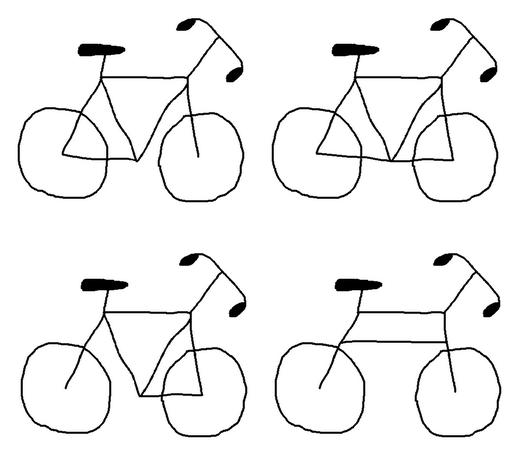
And for those of you who already know how to ride a bike, don't be overconfident about your skills. There is still a lot all of us can learn as the below psychology experiment which I just failed demonstrates (excerpt and photos are from May 9, 2012 YANSS Blog):

Take a look at those bicycles at the top of this post. Which one would you say is the most accurate portrayal of a real bike? Psychologist Rebecca Lawson once put together a study that revealed even though most people are very familiar with bicycles and know how to ride them, they can’t draw one to save their lives, and they can’t even pick a proper one out of a lineup. Despite this, most people rate their knowledge of how a bicycle works as being very good. Remember that when someone claims to understand something a bit more complicated, like a sub-prime mortgage. (This is a picture of a real bicycle.)


Sunday, April 03, 2011

Manufacturing Entrepreneurs


I think every politician/economist in the world has by now accepted the fact that entrepreneurship is vital to long-term economic growth and prosperity. Much less understood, however, is how one would best go about creating more entrepreneurs in the society.

Do you create more entrepreneurs by copying "Silicon Valley" (whatever that means)? Do you do so by pouring more money into science education and R&D? Or by giving more tax incentives for engaging in entrepreneurial activities? Or is a liberal-arts education the missing ingredient, as Vivek Wadhwa recently suggested in The New York Times and TechCrunch?

As an entrepeneur with a liberal arts background (Philosophy, Economics, and Law), I do firmly believe that having had some exposure to the liberal arts is of great value in leading a well-rounded and grounded life. However, when it comes to entrepreneurship, I am not sure how much credit I can justifiably give to my liberal arts training.  As a matter of fact, I think the role of financial incentives, sciences as well as the liberal arts in creating more entrepreneurs in a society is quite limited at best. In other words, they may be considered necessary conditions for more entrepreneurship, but by no means sufficient. This is supported by existence of plenty of countries/states/regions/universities in the world that produce excellent scientific and liberal arts scholars and provide lots of tax incentives for entrepreneurial activities (such as in Canada), but those efforts do not produce the desired entrepreneurial activity in the target population who opt for more traditional career paths.

Why? Because the emphasis on  individual incentives and particular college degrees misses the essence of entrepreneurship, which is fundamentally a social activity and therefore mostly influenced by the prevailing culture. Some cultures (be it within a society, a company or a single family) kill entrepreneurship desires while others nurture and grow it.  In my experience, entrepreneurship only thrives in a culture that is forgiving towards those who fail at taking entrepreneurial risk.

Wherever I have seen strong cultural punishments (e.g., guilt, shame, etc.) associated with failed entrepreneurial endeavors (as in Canada, Germany and so many other societies), entrepreneurship has been stifled. Conversely, the culture in Silicon Valley intrinsically celebrates and values taking entrepreneurial risks. Having had near-hits with one's past ventures, in the Valley, is something to be proud of (even brag about) rather than hide. Behind most successful Valley executives and entrepreneurs is usually a trail of failed prior attempts. Counter-intuitively to outsiders, past misses make an entrepreneur even more "fundable", as those experiences are deemed invaluable to VC's and Angels alike.

Regardless of whether the Valley mindset was created by amazing foresight or sheer historic accident, it is apparently exactly what our mammalian brains need to take on risk. According to a recent psychology experiment recounted by Jonah Lehrer on his blog, our brains' pleasure centers hardly distinguish between almost winning and actually winning, which explains why so many people flock to Vegas and actually enjoy throwing hard-earned cash at one-sided gambles. He goes on to provide an evolutionary explanation:
Why would the mammalian brain be designed this way? One answer is that we didn’t evolve for Vegas. Rather, near misses help us stay motivated when engaged in activities that require actual skill, and not dumb luck. Let’s say we’re learning to play basketball. At first, our shots are going to be all over the place, a seemingly random distribution of bricks and airballs. And yet, as we slowly get better, those shots will get closer to the rim. A few might even go in, which is pretty thrilling. The purpose of near misses, then, is to keep us motivated while we slowly improve our form. If we only got excited by makes, we’d quickly give up, which is why the brain also needs a mechanism to register progress.
Now imagine that you lived in a society where everytime someone missed the basket during training or in a game, they were boo'ed off the court or worse yet, threatened that they could never play basketball again. How many star basketball players would that society produce?

Just like in professional sports, entrepreneurship requires "actual skill, and not dumb luck." If the culture discourages risk taking entrepreneurial endeavors by punishing those who fail at it, then you start messing with those brain centers responsible for motivating people to become entrepreneurs in the first place. In which case, no amount of rewards, tax incentives, scientific or liberal arts education can motivate people to get in the game and start practicing.