Showing posts with label startups. Show all posts

Sunday, March 30, 2014

Can your startup be data-driven and proactive at the same time?

http://www.livescience.com/32812-why-do-bird-flocks-move-in-unison.html
In the startup world, we have come to appreciate the power of empirical evidence, A/B tests and data-driven decision making. We strongly expect (even outright assume) that our startup founders, leaders and decision makers ground their leadership decisions on hard, solid data (as opposed to personal whims, dreams or anecdotal tales). At the same time, being proactive has always been a prized leadership skill. But if we define "being proactive" as the ability to address a problem or opportunity before there is data about that problem or opportunity, it seems irrational to demand from someone to be proactive and data driven at the same time!

I was confronted with this dilemma last week while discussing the implications of a new feature release with a product team. The aforementioned release would introduce some changes that could potentially make a small percentage of the existing user base of the product unhappy. But no one really knew the size or the extent of unhappiness caused here. Should the product team be proactive and try to fix the problem by delaying the launch, or instead, be agile and launch immediately, only to react to problems if and when they arise afterwards? What if one hour after the release, one user voices very strong dissatisfaction with the release. Do you roll back the release or wait until you receive complaints from at least x% of your users before you decide to do something about it?

I think there are 2 keys to resolving this dilemma in any organizational setting: (1) Clear Product Vision, and (2) Personal Experience. A clear product vision in the organization enables everyone involved to make proactive decisions by prioritizing those decisions against the furtherance of that overarching vision. If the organizational product vision is to provide the "best customer service in ecommerce", for instance, then the decision on whether or not to argue over a customer's desire to return a merchandise can be easily made without having to make elaborate calculations about the impact of the decision. Personal experience, on the other hand, enables the decision maker to spot trends early on and extrapolate inferences from limited data sets that may not, in and of themselves, be statistically significant.

So it seems quite important for the leadership in a startup to recognize the inherent dilemma between data-driven decision making and proactive leadership and to take steps to ensure that there is a clear product vision driving the organization forward, while at the same time leveraging prior experience of team members, advisers or consultants in making inferences from past data.

(Photo Credit: livescience)

Wednesday, December 11, 2013

Get the QUESTION right

I started this post to share some reflections on a classic Depeche Mode song (Get the Balance Right) and how it says a lot about entrepreneurship in its quirky satirical way, but my (evidently unbalanced) subconscious took me back to a startup Board interaction I had recently witnessed. So now I am compelled to share that story instead:

I painfully saw how an entrepreneur who had obviously spent many days of his invaluable startup time researching an answer to a prior Board request get slammed by a Board member for doing so.  This is not because the data the entrepreneur had painstakingly uncovered was bad, statistically insignificant or irrelevant, but because the data was ANSWERING THE WRONG QUESTION.

As entrepreneurs we face a million questions a day that cannot wait to be answered. Answering each one takes time and effort away from answering the others, and in may times, raises even more questions. It is imperative that we truly understand the initial question we are trying to answer before spending efforts to answer it.

Here is a process I would follow to see if you've got the question right:

  1. Repeat the question out loud (even if it is you)
  2. Imagine the best and worst answers to the question
  3. Would the answer have any actionable implications?
  4. If not, ask the inquiror about purpose of question
Repeat steps above until everyone believes there is a question worth answering with a clear, actionable purpose that it achieves
This may seem like a lot to do, but it is a lot less effort than the wasted efforts spent on answering the wrong question (not to mention the demoralizing prospect upon finding out).

So, here is to getting the questions right!


Monday, July 01, 2013

How to Hack Your Life Into Flow


To have a productive, enriching and fulfilling life, many psychologists (as well as coaches, gurus, athletes, performers, ...) recommend incorporating as much "flow activities" into your life as possible. Flow activities are basically those in which you immerse yourself willingly and totally, and emerge from them with a continued sense of achievement (e.g., learning an instrument or new language).

To find flow in your hobbies is just a preview of what is possible. The basic concepts of flow can be (and for your sake, should be) extended to our personal as well as professional life. But how do we do that? To me, it is all about our personal approach and perspective (Weltanschauung) on life. In fact, the answer seems to be hiding in plain view, at the intersection of two questions about the most ancient human mental and physical activities:

1) Is life more like a game of chess (predictable, deterministic) or backgammon (where randomness and skill play off of each other)?

2) Is life more like a marathon (where endurance reigns supreme) or a sprint (where episodic bursts of energy need to be followed by periods of rest and rejuvenation)?

My bias and response to these questions is obvious from the diagram above (inspired by weekend conversation with a new and cherished friend, Jerzy).

What do you think? Please share your insights.


Friday, January 11, 2013

Yup, Culture Is Usually the Real Culprit!

It has already been a great year so far.  Many blessings on the family front have kept pace with new intellectual pursuits and personal growth opportunities, all resulting in a flurry of 24/7 excitement and activity around my neck of the woods.

Amongst all that excitement, I still couldn't help but take special personal delight in reading Brad Garlinghouse's recent post on LinkedIn, "What I got wrong in the Peanut Butter Manifesto". Brad, a visionary ex-Yahoo executive wrote the now-legendary "Peanut Butter Manifesto" six years ago, a leaked internal memo in which he pointed out "lack of focus, accountability and decisiveness" as Yahoo's critical problems at that point. He aptly prophesied Yahoo's talent exodus and steady subsequent decline in relevance in the world (until Marissa Mayer).

Now, with the benefit of hindsight and reflecting on his role as the chief executive of YouSendIt, Brad has a revised perspective. Namely, he is now convinced that the problems he pointed at Yahoo were mostly symptoms of a much deeper ailment, one that we could summarize as lack of an entrepreneurial culture:
[Yahoo's] core culture no longer encouraged and celebrated innovation with the same zest and ardent ambition to change the world—too often this had been displaced by half-hearted maintenance of the status quo.

...Great products don’t come out of thin air. They are an outcome of environments where innovation can thrive and talented people are encouraged to be bold.

Sure, one-hit wonders can happen anywhere, but companies that stand the test of time all recognize a fundamental truth: great people build great products and great people gravitate towards great company cultures. The startup culture that Steve Jobs created at Apple to transform a declining computer manufacturer into the creator of era-defining products is an obvious example.

...If a business has to be told that it needs more focus, accountability and decisiveness, there is a bigger problem at hand. Truly successful businesses encourage these qualities innately by creating and fostering a culture that inspires each individual to perform at their peak and rewards passion and results without peanut buttering the end of year bonus.
As I had previously written, the right culture within your organization serves as a success accelerant. The existence of an innovative entreprepeneurial culture is as electrifyingly palpable as its lack is stultifying and stale. But it does not come about by accident. It requires deliberate, relentless acts by the founding team. And it leaves its fingerprint throughout the organization, from the arrangement of desks, to employment policies, perks and benefits, allowed play time, hours worked, mission statement, and even the actual product(s) produced.

As founders, what are some of the things you do to maintain the entrepeneurial culture within your startup? How has that culture helped you achieve your goals?
 

Sunday, November 25, 2012

Bike Like An Entrepreneur

 Assuming you know how to bike, can you imagine learning to do so by reading some books, watching some movies, and listening to a bunch of lectures by some of the most prominent bikers of the time? Exactly! You cannot learn how to bike unless you jump on a bike with some training wheels and then over time start taking off those training wheels.

The same is true of entrepreneurship. Entrepreneurship is a skill, and skills are acquired through practice. There is simply no shortcut around it. Desiring a shortcut, in fact, would mean you are missing the whole point. It is like wanting to know how to ride a bike without having to ride a bike.

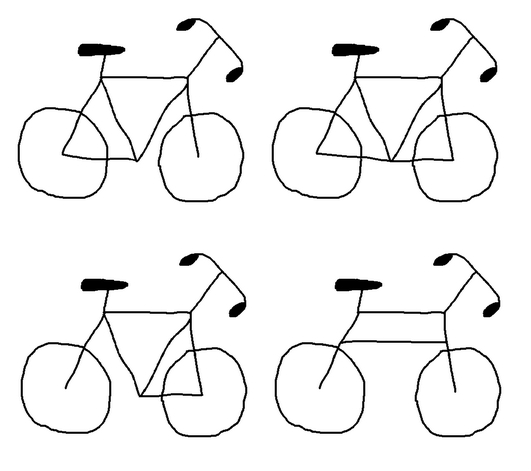
And for those of you who already know how to ride a bike, don't be overconfident about your skills. There is still a lot all of us can learn as the below psychology experiment which I just failed demonstrates (excerpt and photos are from May 9, 2012 YANSS Blog):

Take a look at those bicycles at the top of this post. Which one would you say is the most accurate portrayal of a real bike? Psychologist Rebecca Lawson once put together a study that revealed even though most people are very familiar with bicycles and know how to ride them, they can’t draw one to save their lives, and they can’t even pick a proper one out of a lineup. Despite this, most people rate their knowledge of how a bicycle works as being very good. Remember that when someone claims to understand something a bit more complicated, like a sub-prime mortgage. (This is a picture of a real bicycle.)


Tuesday, November 01, 2011

Products "R" Features


As a freshly minted Associate at a venture capital firm in early 2000's, I recall that one of my criteria for evaluating investment opportunities was figuring out (with analytic precision, of course) whether a particular startup was really a "product" or a "feature"... Turns out that was a totally futile (if not counterproductive) exercise!

So many of today's über-successful startups in fact are nothing more than features. Google started out as a feature inside a portal (Yahoo) and who knows, may end up being a feature inside a social network or mobile device 5 or 10 years from now. And look at all these neat features on your smart phone called Apps! Wouldn't you have loved to invest in some of the popular ones, like Angry Birds?

I think the traditional problem with investing in "feature" companies is the concern that a "product" company in that industry, with its seemingly infinite resources, can one day easily roll out that feature and crush that "feature" company. Sort of like how Apple crushed (wink, wink, nudge, nudge) Siri to the tune of over $200 million and Google crushed YouTube for $1.7 billion...

Suffice it to say, lots of great VC investments can be made in things that may be considered mere features today, but will end up being far more revolutionary and game-changing than many products in the market.  In the long run, we will all be dead and all products become features anyway!

Monday, October 10, 2011

Steve Jobs: The Founder Archetype


I started this post with a list of my top 10 favorite things about Steve Jobs, but soon realized that any such attempt is futile at best. As the Da Vinci of our time, Steve Jobs' accomplishments were not limited to a set of inventions, principles, or theories. They spanned multiple disciplines (comp sci and art, for example), multiple decades (starting with the 80's, remember the original Mac?), and will have far reaching implications into the future (wearable computing, for instance).

But the one thing that will make him forever immortal, IMHO, is the fact that he has established himself as the "Founder Archetype" for as long as entrepreneurship will exist. His passion, ambition, perseverance, dedication and determination will be that which all founders will be judged by and compared against. He has truly upped the game for all of us; and that maybe his greatest legacy!

P.S. For some inspiration on how others are preparing themselves for this challenge, you may want to read and follow #LiveLikeSteve

Tuesday, June 21, 2011

Culture As Startup Accelerant

After all is said and done, culture is the glue that holds a society together, enabling it to overcome all sorts of difficulties. The importance of culture, however, becomes magnified in a startup setting, as succinctly put by Nilofer Merchant in a recent post on Harvard Business Review's blog:
Success is a function of Purpose, Talent, with a Culture accelerant. Or: S = (PT)C
Culture drives that much-valued-yet-elusive exponential growth that every founder dreams for their startup. Without that certain culture, no matter how many smart and talented people you gather around the table, and regardless of how great the mission you embark upon, you are unlikely to succeed. Why? Because all those well-intentioned smart people start getting in each other's way, and sooner or later, end up sabotaging each others' efforts rather than leveraging one another, and thus slowing progress, innovation and growth.

I must admit, I have never seen a successful startup whose employees detected the existence of a "bad" or "disfunctional" culture, and plenty of unsuccessful ones where that was exactly something (perhaps the only thing!) employees could agree on.

Culture is exactly why the founders are critical to the success of their startups: They are the ones who set the culture (just by sheer chronology of events) and can either maintain or destroy it over time (just by sheer action or inaction over time). Founders who are unaware of the critical role they play in fostering a productive culture within their startups have some very hard lessons to learn. The following are some examples of "peopley stuff" (Nilofer's phrase) that founders have a direct impact on:
  • Level of trust between employees
  • Level of collaboration among employees
  • Time spent on politics and CYA stuff by employees
  • Attitude towards risk and innovation by employees
  • General good-will of employees towards success of enterprise
  • Hours that employees put in at work
  • Hours that employees work during the week
  • Hours that employees dream about work (in a good way)
And this is just scratching the tip of the iceberg!

Sunday, March 20, 2011

Innovation Déjà Vu (or The Idea Clone Wars)

I think we are all too familiar with how every now and then several Hollywood movies come out with the same basic plot in relatively short succession. Here are some of my favorites (not in Oscar-worthiness, but in how much of a clone the movies are of each other):

Matrix, Dark City, & Thirteenth Floor;
Deep Impact & Armageddon;
Antz & A Bug's Life;
Finding Nemo & Shark Tale;
The Truman Show & Ed TV;
Volcano & Dante's Peak;
War of The Worlds (with Tom Cruise) & War of The Worlds (without Tom Cruise);
United 93 & World Trade Center;
etc.

This, of course, is not a coincidence as pointed out in a study published in this 2006 Whittier Law Review article by IP attorney Igor Dubinsky:
Movies arise from scripts, scripts arise from ideas, and while ideas, as Justice Brandeis noted, are “free as the air,” they must be nurtured by authors to present any real value. Once an author gives birth to an idea for a story or movie, he develops it and then attempts to sell it to a movie studio. If the author can secure a meeting with a studio executive, he presents his idea at an “idea-man” presentation. Alternatively, the movie script can be submitted to a studio via mail or a third person.

On the average, movie executives receive over 20,000 movie and TV show ideas per year, but only review 6,000 of these, many of them over meals with executives from other networks. Movie ideas come from various sources including Sunset Boulevard, network executives, the studios themselves, stars and their agents, independent producers, writers, word of mouth, trade papers, and magazines... Only about 200 sample scripts are commissioned per year, and seldom are more than twenty of those
ordered.

Sometimes the person who conceived the idea for a movie script will win a meeting with studio executives, only to have the idea rejected and then rewritten and developed by the executives without paying any copyright royalties to the original author. What happens even more often is that a script author will shop the same idea at numerous movie studios, or movie studio executives at different companies will discuss with each other ideas for movies they are thinking of putting into production. These same ideas will then be developed into movies by two or more competing studios. At the box office these similar movies will come out like déjà vu, within a few weeks or months of each other.   
Are the same nefarious forces at play when we see a sudden rush of group texting startups (hat tip to George Zachary for the apt tweet on this), location-based services, social commerce websites (aka Groupon clones), VoIP startups (ok, I participated in that Clone War by starting jaxtr, a "j" letter mobile VoIP company in 2005), etc?

As the parallels between Hollywood and Silicon Valley in the above excerpt are too obvious to point out, I would like to share with you a more generalized response, which is the following:

Innovation in Silicon Valley is as much a social process as is ideation in Hollywood. We need to talk to others to be able to refine and solidify all the various thoughts that swim around in our heads. The good thing about this social process is that we come up with better results because of it (a recent study points out that the best academic articles are those that are produced by teamwork rather than "solo geniuses"). The bad thing, however, is that as soon as we talk to one other person, we will have to accept the fact that there will undoubtedly be a multitude of others that will have the same idea planted in their heads and will want to do something with it. If you want to innovate, the clone wars are inevitable!

Monday, November 22, 2010

Zen and the Art of the Start

Although I am at a loss when it comes to giving a prescription for how to become a successful entrepreneur, I can give it a description based on my observations of a few of my personal heroes: And it is that all successful entrepreneurs seem to be quite Zen!
The way I understand it, the mastery of Zen comes from an acceptance of the way things are, and embracing all contradictions inherent in our human condition, thereby becoming a catalyst of what has always meant to be. A Zen artist enables the manifestation of joy, happiness and beauty in the world. A Zen warrior fights the just cause in many instances without engaging in a single battle. And a Zen entrepreneur succeeds in changing the world without forcing any changes upon it. It is being a walking contradiction that makes sense: actively forcing your mind to be passive, so that life experiences are not tainted by the prejudices, fears and judgments of the mind. It is setting your ego aside, so that something much much bigger can inspire and drive your actions.

As an entrepreneur, you are constantly struggling with sanity and insanity, creation and destruction, calm and anger, fast and slow, among many other things. But unlike the acrobat or tightrope walker who tries to achieve a balancing act by using opposing forces to neutralize each other, great entrepreneurs embrace the extremes and create a union from these seemingly un-unitable forces that is a much stronger creative force than any extremist could achieve. Thus, the successful entrepreneurs seem to have a mastery of how the flow of life comes from a union of Yin and Yang, which is the essence of Zen.

Sunday, October 31, 2010

How to Avoid VC Nightmares

Apropos for Halloween night, I like to dedicate this post to some of the investor horror stories that circulate around the entrepreneurial community in Silicon Valley in hushed whispers. Without naming names, I have been privy to the gory details of a few such stories (Oh, the Horror!), which typically fall into 3 categories:

(A) Our VC forced us to sell too early and we left all of the upside on the table
(B) Our VC stopped us from selling when we should have, and now I have nothing to show for it
(C) Our VC drove me out of my company/business at the worst possible time, leading to its eventual demise

Needless to say, this is not an exhaustive list and textbooks, in multiple volumes, can be dedicated to collecting all the various gripes entrepreneurs have against their investors. Typically, in my experience, the complaints are leveled against professional venture capitalists (VCs) rather than the angel investor individuals or groups, although the emergence of institutional Super Angels may change things in the future. And so, I will continue the rest of this post by focusing on VCs and how you may avoid becoming another cautionary tale in your dealings with them.

Is the "Horror" real?

In my last post, I described how bad investors can kill your company. That horror is definitely real. Anecdotally, the depth and magnitude of grievances against VCs can only compete with one other group of professionals: LAWYERS! With the exception that there aren't as many VC jokes out in circulation because many of us still hope to raise some money from the VCs and don't want those jokes to be digitally traced back to us. (Although, as a former lawyer and VC, I do find the negativity with both professions to be somewhat... hyped).

And then sometimes the entrepreneurs are so deeply hurt (physically, psychologically and/or financially) that they throw caution to the wind and decide to drop a nuclear bomb on their bridge to the VC riches by going after them in the court of law (see, e.g., Epinions founders suing Benchmark and August Capital) or in the court of public opinion (see, e.g., ArsDigita co-founders' revelations). There is even a growing Quora thread on this topic.


In summary, this is spooky stuff indeed!

Antidote: Investor due diligence

Although it is hard to have any real guarantees, should you find yourself in need of VC money, doing your homework on your investors can lessen your risk and improve your chances of picking the right investors.

First thing to remember is that not all VC's are created equal. There are worlds of difference between VC firms and even between partners in the same firm. So, start your preliminary diligence well before you even send out your Executive Summary. And make sure to really dig in before you go too far down the path of negotiating a term sheet, as it becomes exponentially harder (if not impossible due to cognitive dissonance) to switch investors once you have a signed term sheet in place.


Things to investigate during diligence

Although it seems like a daunting task that would necessitate hiring an elite PI agency with former CIA/IRS credentials, most of the important stuff you would be looking for is already out there for you to see.

Reference Checks. Talk to former founders/executives that the VC firm (and more importantly, the partner on your deal) has invested in. Make sure to talk to companies where things did not go super smoothly (names of which you will most likely have to dig out on your own). Try to get a feel for how it is to work with this firm/partner during good times and hard times. Their behavior during hard times is especially important as I had mentioned before.

Portoflio Size and Composition. You need know how many other portfolio companies does the VC firm/partner care about, and whether they actually have the bandwidth to do the things you expect them to do. Also, you need to get a feel whether you fall within the sweet spot of the kind of companies this firm does well with, or you are one of the outliers. Then check against your gut to see how you feel about that. Also, note that typically larger firms with larger porfolio sizes tend to push their investments towards higher exit multiples rather than allow for earlier liquidity.

Porfolio Integrity. This is something that is often ignored. Does this firm have a history of investing in competitive companies in the same field? Some VCs actually do that. You need to know the truth, because as a portfolio company, you cannot stop your VCs from investing in your competitor if they chose to do so.

Number/Amount of Investments. Find out, over the lifetime of the current fund, how many investments the firm/partner is expected to make, and how far they are currently from meeting that quota and deploying the cash invested in them. This matters, because it will determine the amount of attention and care your startup is likely to get over the next few years. Also, if the firm is towards the end of the lifetime on their fund they will be more likely to look for faster liquidity events and will be very distracted during their upcoming fundraising cycle.

Available Funds. You need to have a realistic picture as to how much more cash this investor is likely to deploy into your company, which is a function of how much on average they spend on each portfolio company and whether they have enough cash left in the fund to satisfy that obligation given existing and projected investments.

History of Lawsuits/Disputes. You need to know whether the firm/partner on your deal is or has been involved in lawsuits. Again, those lawsuits can tell you a lot about skeletons in the closet, as well as the distractions that will likely take the attention of the firm away from you.

Risk Profile. Another thing to get a sense for is whether this firm/partner has the wherewithal to take some serious risks and take a market position (the way such firms like Kleiner Perkins or Sequoia Capital do), or whether they like to play it safe and will abandon you/your vision after hitting a rough patch.

Most of the above information is readily obtainable. It does take some investment of time, but can you afford not to spend the time on them?

Happy Halloween!

Friday, October 01, 2010

Coupons are dead; long live the coupons!

My main takeaway from spending the better half of last week at SF TechCrunch Disrupt conference (an event some may call “Silicon Valley’s Academy Awards”) is as follows: 2010 will go down in history as the year a swarm of startups finally managed to kill traditional coupons. 

The “traditional” coupon industry is doomed to die a slow death-by-a-thousand-cuts, inflicted by a gaggle of mobile check-in startups taking advantage of the newly-found access to users’ locations. As each location-based startup came onstage at Disrupt, I could almost hear the Julius Caesars of today’s coupon empire yell out in anguished unison, “Et tu, Brute?”

Of course, the fundamental economics behind coupons (i.e., the concept of using price discrimination to distinguish customers by their reserve price and thereby generating the maximum sales/revenues/profits), has not changed. As a matter of fact, location-based startups are following the same economic principles by hoping to provide an efficient delivery mechanism for providing the ideal discriminatory pricing scheme; a task that is no less ambitious than Pierre Omidyar’s vision for eBay to materialize a “perfect market” (the theoretical economic concept where there is perfect access to information and zero transaction costs). 

Providing location-based coupons is not an entirely new idea. People have been handing out coupons and promotional material on the sidewalks at most metropolitan areas for ages. 

And the concept of virtual coupons is not entirely new either. I recall reviewing business plans at the start of the decade of a number of startups who wanted to send people coupons via SMS based on their location. And, just as I felt ten years ago when reviewing those business plans, I remain highly skeptical whether the new check-in Apps that tap into your social graph and GPS location data can actually overcome the negative emotions associated with someone disturbing your stream of activity by putting a “deal” in front of you (sort of like the feeling you get when as you walk down the street someone suddenly hands you a flyer). 

There is a fine line between annoyance and value. I get annoyed when I am distracted, but I love it when someone anticipates what I need and puts it in front of me (something Google tends to do very well with their search advertising). Whoever manages to get closer to the latter of the two will likely be quite successful. I, however, have not found such a service yet, and find all of the current location-based check-in Apps to be either useless or extremely invasive. In fact, the only "price discrimination" these Apps currently provide is to generously give discounts to folks who need them the least, as the iPhone/Android/smart phone demographic is among the least price sensitive demographic you can find!