This TED talk is an awesome reminder that innovation is not a solitary endeavor but an incremental heaping of hunches in seemingly random coincidences.
Sunday, June 14, 2015


Monday, February 02, 2015
Saturday, January 31, 2015
Of Puppies and Men

By now most of you have heard about GoDaddy's #Puppygate controversy this week. It was quite something to experience from inside, and see how the right culture can make a huge difference in how you react to mistakes. In fact, it was quite a throwback to an older blog post I had made on this very same topic. So, instead of finger pointing and rolling heads, the GoDaddy team listened, regrouped, and decided on a set of constructive next steps starting with a statement by our CEO Blake Irving within hours on the same day.
Also, I am personally happy that in the process, many people who didn't know much about the plight of some puppies got a much better understanding of the realities involved with breeding as pointed out by this animal advocate on Huffington Post.
Now let's see what tomorrow has in store for Superbowl and its advertisers!
May the nimblest team with the right culture towards mistakes and experimentation win!!!
Sunday, March 30, 2014
Can your startup be data-driven and proactive at the same time?

I was confronted with this dilemma last week while discussing the implications of a new feature release with a product team. The aforementioned release would introduce some changes that could potentially make a small percentage of the existing user base of the product unhappy. But no one really knew the size or the extent of unhappiness caused here. Should the product team be proactive and try to fix the problem by delaying the launch, or instead, be agile and launch immediately, only to react to problems if and when they arise afterwards? What if one hour after the release, one user voices very strong dissatisfaction with the release. Do you roll back the release or wait until you receive complaints from at least x% of your users before you decide to do something about it?
I think there are 2 keys to resolving this dilemma in any organizational setting: (1) Clear Product Vision, and (2) Personal Experience. A clear product vision in the organization enables everyone involved to make proactive decisions by prioritizing those decisions against the furtherance of that overarching vision. If the organizational product vision is to provide the "best customer service in ecommerce", for instance, then the decision on whether or not to argue over a customer's desire to return a merchandise can be easily made without having to make elaborate calculations about the impact of the decision. Personal experience, on the other hand, enables the decision maker to spot trends early on and extrapolate inferences from limited data sets that may not, in and of themselves, be statistically significant.
So it seems quite important for the leadership in a startup to recognize the inherent dilemma between data-driven decision making and proactive leadership and to take steps to ensure that there is a clear product vision driving the organization forward, while at the same time leveraging prior experience of team members, advisers or consultants in making inferences from past data.
(Photo Credit: livescience)
Wednesday, December 11, 2013
Get the QUESTION right
I started this post to share some reflections on a classic Depeche Mode song (Get the Balance Right) and how it says a lot about entrepreneurship in its quirky satirical way, but my (evidently unbalanced) subconscious took me back to a startup Board interaction I had recently witnessed. So now I am compelled to share that story instead:
I painfully saw how an entrepreneur who had obviously spent many days of his invaluable startup time researching an answer to a prior Board request get slammed by a Board member for doing so. This is not because the data the entrepreneur had painstakingly uncovered was bad, statistically insignificant or irrelevant, but because the data was ANSWERING THE WRONG QUESTION.
As entrepreneurs we face a million questions a day that cannot wait to be answered. Answering each one takes time and effort away from answering the others, and in may times, raises even more questions. It is imperative that we truly understand the initial question we are trying to answer before spending efforts to answer it.
Here is a process I would follow to see if you've got the question right:
So, here is to getting the questions right!
I painfully saw how an entrepreneur who had obviously spent many days of his invaluable startup time researching an answer to a prior Board request get slammed by a Board member for doing so. This is not because the data the entrepreneur had painstakingly uncovered was bad, statistically insignificant or irrelevant, but because the data was ANSWERING THE WRONG QUESTION.
As entrepreneurs we face a million questions a day that cannot wait to be answered. Answering each one takes time and effort away from answering the others, and in may times, raises even more questions. It is imperative that we truly understand the initial question we are trying to answer before spending efforts to answer it.
Here is a process I would follow to see if you've got the question right:
- Repeat the question out loud (even if it is you)
- Imagine the best and worst answers to the question
- Would the answer have any actionable implications?
- If not, ask the inquiror about purpose of question
So, here is to getting the questions right!
Tuesday, July 23, 2013
Top 10 Ways To Scare Startup Lawyers (+VCs + Acquirors)

As I was preparing for my presentation for Founder Institute yesterday, I compiled this list over a few chuckles. Hope you also enjoy it :)
- Do all your legal work through DIY online forms (from formation to option grants and key contracts)
- Get a personal injury lawyer to do your patent and trademark filings, cheaply.
- Don't read anything about basic startup law, especially disclosure obligations, fiduciary obligations, and stock pricing rules.
- Forget about IP strategy. If anyone asks about your views on trade secrets, talk about NAFTA!
- Ignore regulations in your industry (especially for healthcare, life sciences, financial and legal startups)
- Burn/shred/ignore threat letters ("nastygrams") by former employers, co-founders, contractors, users, competitors, etc.
- Ignore all user feedback on product, from support inquiries to social media and BBB postings
- Miss your 83(b) 30-day filing deadlines
- If your Board forgets to grant options, go back and re-do it after the fact
- Send an email to everyone on your contact list asking for investment in your startup
If any of the above sounds remotely like something you may have considered doing, please, please, please don't do it! You are in desperate need of immediate help, so talk to someone who knows a bit about startup law today.
Monday, July 22, 2013
Startup Legal & IP
Here is a presentation I gave to a bunch of very smart founders and entrepreneurs at Founder Institute tonight, drawing on my past 14 years of experience in Silicon Valley. It was so fortuitous to give this presentation at Wilson Sonsini, the place where I started my Valley career as a lonely Associate in 1999.
Tuesday, July 16, 2013
Don't Waste A Mistake!
Something that a lot of good parents know is that you gotta let your kids make mistakes. In fact, that's the only way they can learn and grow as confirmed by years of research in developmental psychology (see, e.g., Remember, Mistakes are for Learning). It's no different for adults either. Nonetheless, when we as entrerpeneurs are in the midst of startup activity, with all the confidence, optimism and forward-looking stamina in the world, we tend to try to brush the mistakes aside (if not under a rug) and move on. Who's got time for all that when you are trying to disrupt the course of mankind?
Problem is, without learning from mistakes we are bound to... you know the rest. So, how do we reconcile the desire to rapidly move forward while also learning from mistakes?
The magic solution to this dilemma is in that elusive notion of "startup culture" that I have been referring to many times in this blog. If your culture is one in which mistakes are punished and viewed as shameful and reflective of your worth as a team member, or worse, human being, good luck to you. You will be chasing your tail to infinity.
On the other hand, a culture that welcomes mistakes as opportunities to learn and grow from tends to be one in which not only innovative ideas find roots, but also find the optimal path(s) to grow among the many good and bad possibilities. Our attitude towards mistakes is what determines our ability to learn from them. Again, there is ample research data to confirm these in case you are interested (see, e.g., )
Here is an excerpt from Better by Mistake: The Unexpected Benefits of Being Wrong by Alina Tugend that captures some components of a productive, healthy attitude towards mistakes as applicable to parenting as it is to running a startup:
There are no simple fixes, but there are ways all of us can shift our thinking about mistakes. Starting with our children, we can emphasize effort and deemphasize results. We can appreciate that we -- and they -- can't be perfect, nor is it a goal we should aim for. We should strive to do our best, but if the prize is ever-elusive perfection, then the fear of failure will too often overshadow the willingness to experiment, take risks and challenge ourselves. We should be careful of the contradictory message that it's all right to make mistakes but not where it counts...
Assuming you have bought into the idea that it is better to learn from mistakes than to shove them under the rug, here are some practical steps you can take in that direction when encountering a mistake (be it a bug in your release, catching spelling errors in your expensive ad campaign, misplacing an important document, etc):
1. Always be grateful when a mistake is found. Catching it later would have been worse at the least.
2. Express your gratitude and make sure your body language confirms that.
3. Don't focus on who is responsible, but for what went wrong.
4. Shed light on the situation in a collaborative, problem solving session focused on learning
5. Brainstorm on ways to catch that kind of mistake earlier in the future
6. Focus on learnings and action plan moving forward
Some other quick, noteworthy readings on this topic include:
Fred Wilson's Don't Let a Good Crisis Go to Waste
Jessica Stillman's Don't Let a Good Mistake Go To Waste
Monday, July 01, 2013
How to Hack Your Life Into Flow

To have a productive, enriching and fulfilling life, many psychologists (as well as coaches, gurus, athletes, performers, ...) recommend incorporating as much "flow activities" into your life as possible. Flow activities are basically those in which you immerse yourself willingly and totally, and emerge from them with a continued sense of achievement (e.g., learning an instrument or new language).
To find flow in your hobbies is just a preview of what is possible. The basic concepts of flow can be (and for your sake, should be) extended to our personal as well as professional life. But how do we do that? To me, it is all about our personal approach and perspective (Weltanschauung) on life. In fact, the answer seems to be hiding in plain view, at the intersection of two questions about the most ancient human mental and physical activities:
1) Is life more like a game of chess (predictable, deterministic) or backgammon (where randomness and skill play off of each other)?
2) Is life more like a marathon (where endurance reigns supreme) or a sprint (where episodic bursts of energy need to be followed by periods of rest and rejuvenation)?
My bias and response to these questions is obvious from the diagram above (inspired by weekend conversation with a new and cherished friend, Jerzy).
What do you think? Please share your insights.
Wednesday, February 20, 2013
The Startup of You
Anyone interested in having a fulfilling career ought to read The Startup of You by Reid Hoffman, one of Silicon Valley's exemplary and visionary entrepreneurs behind successes such as Paypal and LinkedIn. However, if you don't have time to ready the book, take a quick look at the following slides which do a phenomenal job of delivering the key messages in the book. ENJOY!
Friday, January 11, 2013
Yup, Culture Is Usually the Real Culprit!
It has already been a great year so far. Many blessings on the family front have kept pace with new intellectual pursuits and personal growth opportunities, all resulting in a flurry of 24/7 excitement and activity around my neck of the woods.
Amongst all that excitement, I still couldn't help but take special personal delight in reading Brad Garlinghouse's recent post on LinkedIn, "What I got wrong in the Peanut Butter Manifesto". Brad, a visionary ex-Yahoo executive wrote the now-legendary "Peanut Butter Manifesto" six years ago, a leaked internal memo in which he pointed out "lack of focus, accountability and decisiveness" as Yahoo's critical problems at that point. He aptly prophesied Yahoo's talent exodus and steady subsequent decline in relevance in the world (until Marissa Mayer).
Now, with the benefit of hindsight and reflecting on his role as the chief executive of YouSendIt, Brad has a revised perspective. Namely, he is now convinced that the problems he pointed at Yahoo were mostly symptoms of a much deeper ailment, one that we could summarize as lack of an entrepreneurial culture:
As founders, what are some of the things you do to maintain the entrepeneurial culture within your startup? How has that culture helped you achieve your goals?
Amongst all that excitement, I still couldn't help but take special personal delight in reading Brad Garlinghouse's recent post on LinkedIn, "What I got wrong in the Peanut Butter Manifesto". Brad, a visionary ex-Yahoo executive wrote the now-legendary "Peanut Butter Manifesto" six years ago, a leaked internal memo in which he pointed out "lack of focus, accountability and decisiveness" as Yahoo's critical problems at that point. He aptly prophesied Yahoo's talent exodus and steady subsequent decline in relevance in the world (until Marissa Mayer).
Now, with the benefit of hindsight and reflecting on his role as the chief executive of YouSendIt, Brad has a revised perspective. Namely, he is now convinced that the problems he pointed at Yahoo were mostly symptoms of a much deeper ailment, one that we could summarize as lack of an entrepreneurial culture:
[Yahoo's] core culture no longer encouraged and celebrated innovation with the same zest and ardent ambition to change the world—too often this had been displaced by half-hearted maintenance of the status quo.As I had previously written, the right culture within your organization serves as a success accelerant. The existence of an innovative entreprepeneurial culture is as electrifyingly palpable as its lack is stultifying and stale. But it does not come about by accident. It requires deliberate, relentless acts by the founding team. And it leaves its fingerprint throughout the organization, from the arrangement of desks, to employment policies, perks and benefits, allowed play time, hours worked, mission statement, and even the actual product(s) produced.
...Great products don’t come out of thin air. They are an outcome of environments where innovation can thrive and talented people are encouraged to be bold.
Sure, one-hit wonders can happen anywhere, but companies that stand the test of time all recognize a fundamental truth: great people build great products and great people gravitate towards great company cultures. The startup culture that Steve Jobs created at Apple to transform a declining computer manufacturer into the creator of era-defining products is an obvious example.
...If a business has to be told that it needs more focus, accountability and decisiveness, there is a bigger problem at hand. Truly successful businesses encourage these qualities innately by creating and fostering a culture that inspires each individual to perform at their peak and rewards passion and results without peanut buttering the end of year bonus.
As founders, what are some of the things you do to maintain the entrepeneurial culture within your startup? How has that culture helped you achieve your goals?
Sunday, November 25, 2012
Bike Like An Entrepreneur
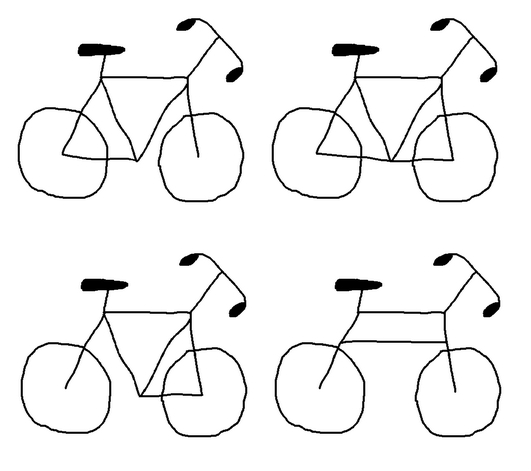
The same is true of entrepreneurship. Entrepreneurship is a skill, and skills are acquired through practice. There is simply no shortcut around it. Desiring a shortcut, in fact, would mean you are missing the whole point. It is like wanting to know how to ride a bike without having to ride a bike.
And for those of you who already know how to ride a bike, don't be overconfident about your skills. There is still a lot all of us can learn as the below psychology experiment which I just failed demonstrates (excerpt and photos are from May 9, 2012 YANSS Blog):
Take a look at those bicycles at the top of this post. Which one would you say is the most accurate portrayal of a real bike? Psychologist Rebecca Lawson once put together a study that revealed even though most people are very familiar with bicycles and know how to ride them, they can’t draw one to save their lives, and they can’t even pick a proper one out of a lineup. Despite this, most people rate their knowledge of how a bicycle works as being very good. Remember that when someone claims to understand something a bit more complicated, like a sub-prime mortgage. (This is a picture of a real bicycle.)

Sunday, November 11, 2012
Which is Better: Greed or Vision?

It is my belief that startup founders who prioritize financial rewards over a specific vision/mission are less likely to succeed/survive compared with visionary founders.
I have seen many knee-jerk reactions to my above position. Here are some of my favorites:
(1) Accounting 101: A business cannot survive without money. Therefore, the quest to generate cash and ultimately profits should be the most important pursuit for a startup and everything else would be of less importance.
(2) HR 101: A startup needs talent to innovate and survive. Without promise of great financial rewards, a startup cannot recruit and retain requisite talent to really make it in a competitive labor market.
(3) Economics 101: As Adam Smith pointed out, all you need for a well-functioning free market is rational, profit maximizing individuals and firms. As long as people/firms engage in profit maximizing endeavors, the society benefits and progress is made. As a corollary, then, pursuing anything else is sub-optimal and is bad for society.
(4) Psychology 101: There is no better incentive than money to motivate behaviour, because money is quantifiable and can be used to obtain other things that individuals may idiosyncratically value. Therefore, the promise of great financial rewards is what makes a company innovate and succeed.
(5) Business Law 101: The founders/board/management of a company owe a fiduciary duty to their shareholders to maximize their return on investment. Therefore, prioritizing any other goal would be a violation of their fiduciary duty and grounds for shareholder lawsuits.
All of these arguments, however, either lack empirical, real-world support, or are actually compatible with my assertion about the vision-driven startups. So, let's take them one by one:
(1) My Reply to Business 101: A business cannot survive without many things. Cash is of course one such thing. So is motivated employees. But even if cash was the only thing without which a business could not survive, it does not logically follow that businesses ought to make profits their primary objective. Take for instance the statement that "A person cannot survive without air." Does it follow then a person ought to make pursuit of air their primary objective in life? Just because something is necessary for survival, it doesn't follow that its pursuit ought to be the objective of life. It is relatively easy to see that in case of human beings, higher goals and objectives are things that make life (and its necessary attributes such as breathing and eating) well worth it, but some of us lose that perspective when dealing with businesses for some reason. A business needs to make money to accomplish its goals, just as a person needs to stay healthy, eat, breathe air, etc. to accomplish its goals.
(2) My Reply to HR 101: I have been a witness to how non-financial rewards play a significant role in recruiting. I have recruited employees away from other startups because of differentiated vision or working conditions, and at many times, people have been willing to take a pay-cut. I have yet to see a single employee for whom the actual dollar value of results was the only factor in their career decisions. (Continued under Psychology 101 below)
(3) My Reply to Economics 101: News flash for Adam Smith followers: Turns out, based on a number of ongoing studies in econ and psych departments worldwide, people are not purely rational, selfish, profit-maximizing agents! People's sense of morality, fairness, empathy, altruism, and other cultural influences significantly inform and impact our decisions. There is even an emerging interdisciplinary field, called neuroeconomics, that is trying to make sense of all the irrational choices people make in their lives. Bottom line, there is too much unknown about human psyche and motivation to make any kind of normative judgment about how markets function. Furthermore, if the primary purpose of all firms in the market was to maximize profits, wouldn't the market ultimately converge on one firm that had figured out how to maximize profits? On the other hand, there are probably as many visions for the future as there are people in the world. Wouldn't the society benefit more if people focused on how to realize their vision?
(4) My Reply to Psychology 101: Although I don't dispute that money is a motivator, I do think its motivational influence is seriously hyped. Throughout history, tens of millions (at least) have been willing to put their lives in jeopardy or even willingly welcomed death in pursuit of their religious, philosophical or social beliefs. How many have done so for greed? In today's transparent labor market where compensations have pretty much converged amongst startups around the same stage, what startups compete on is their vision and sense of purpose. And in my opinion, when the going gets tough, those emplyees who are their for the vision are the ones who are willing to make "irrational" sacrifices (take pay cuts, work longer than legally or medically sanctioned hours) to see the dream come true.
(5) My Reply to Business Law 101: Maximizing shareholder value is not incompatible with giving priority to the vision of the company. This is assuming that the vision was articulated at the time of fundraising. The vision provides the boundary conditions within which the shareholder-value-maximizing activities are to take place. In fact, if the company decides to change course/vision/industry without approval from shareholders, that can land the Board/management team in as much legal trouble when things go south.
Bottom line, you gotta make money, but that doesn't mean you have to give up your dreams (or soul) to do so!
Wednesday, October 31, 2012
Why We Dislike Facebook Ads - Or, The Quest To Preserve Our Free Will

This morning when I was staring at some display ads on Facebook, I could hear myself think "How dare they tell me what I should be clicking on by looking at my profile and activities on the site? Am I not more than a mere formula derived from my Likes, Interests and Comments? They think they have figured me out, but I will show them [and went on to click on a photo rather than an ad]"
And therein lies the dilemma for Facebook. Their ads are only relevant to us, by definition, if they appeal to our interests. But if and when they do truly appeal to our interests, they alienate us by confronting us with the age-old philosophical problem about free will vs. determinism, i.e., the question as to whether or not we are truly in charge of our own actions or whether we are just some sophisticated automaton running a super-fancy script in the background. And when our intuitions about our own free agency get rubbed the wrong way, we react the only way we know how to react, namely by doing the exact opposite of what our manipulators want us to do. That is, we ignore the ads!
The fact of the matter is, however, that manipulation (in its most non-judgmental sense) has become the way of doing business online. All consumer Internet companies are based on running A/B tests that are geared to funnel our online behavior towards the goals of various products, applications and advertisers. And surprisingly, we have a high tolerance for much of that manipulation. We dislike the implied manipulation of ads (unless they are tied to our intentions via search engines), but welcome music recommendations made by Pandora, job recommendations made by LinkedIn or a myriad of other online services that we use on a daily basis, all of which tap into our interest graph and other behavioral data to predict what we like. So, why the discrepancy?
The only way I can make sense of our conflicting intuitions is that in certain circumstances (let's call them "benign manipulations") our sense of free will does not get violated and in others (let's call them "commercial manipulations"), it does. According to some of the leading compatibilist philosophers such as Daniel Dennett (those believing that we can have free will in a deterministic world), our ability to veto manipulations and control what our desires dictate is what gives us the sense of our free will, giving us "the kind of free will worth wanting". Therefore, we don't feel compelled to veto benign manipulations because we feel that upon reflection they are genuinely in our own interests, whereas commercial manipulations compel us to veto them because we suspect they are not truly in our interests. Those commercial manipulations invoke the image of a car salesman, except one that has also peeked inside our brain.
I don't have a prescription for what Facebook shall do with its ads to make them compatible with my sense of free will, but I am glad that I can still have my free will and browse the web.
Saturday, January 21, 2012
An Ode to the Valley
I loved reading Justin Rosenstein's inspirational, heart-felt post Do Great Things on TechCrunch this week. It talks to the same "Death of Big Ideas" phenomenon I blogged about after visiting SXSW Conference last year, and makes a powerful case for why the pursuit of Big Ideas by us, the privileged members of the Valley tech community, is a moral imperative.
You must read Justin's piece in its entirety, but as a preview here are some of my favorite quotations from it:
You must read Justin's piece in its entirety, but as a preview here are some of my favorite quotations from it:
Technology, community, and capitalism combine to make Silicon Valley the potential epicenter of vast positive change.
And with increasingly severe threats to our survival — rapid climate change, an unstable international economy, and unsustainable energy consumption — it is more important than ever that we... change the world, foster happiness and alleviate suffering, for us and our fellow beings.
[I]n the face of threats to humanity’s future on the one hand and the extraordinary potential of mankind on the other, at some point we must ask: are we capable of more?
Life is short, youth is finite, and opportunities endless. Have you found the intersection of your passion and the potential for world-shaping positive impact?
Don’t lose the fire you started with. If you’re going to devote the best years of your life to your work, have enough love for yourself and the world around you to work on something that matters to you deeply... in order to do great things, we must attempt great things.
Why Are Kids Losing Interest in Entrepreneurship?

While 65 percent of fifth and sixth graders plan to start a business, only 34 percent of high school kids do. (see graph below)Thus, somehow as a country we lose 50% of our total entrepreneur population in middle school! And what troubles me even more is the lack of any substantive or serious discussion on this (critical) topic by any politician or educators.
What is amiss?
The Forbes article takes a stab at a response:
For insight into why older kids are less likely than younger ones to plan to start businesses, I turned to my resident expert on what kids think – my fourth grade daughter Hannah. Hannah’s explanation was that kids learn about alternatives to an entrepreneurial career as they get older. As kids become interested in other jobs, the share that plans to start a business declines.But with all due respect to the author's fourth grade daughter, this does not seem to get at the heart of the issue. In my own childhood experience and that of most toddlers, the various white collar and blue collar professions are the first "jobs" that kids get exposed to: Firefighter, Police, Doctor, Nurse, Mechanic, Pilot, Flight Attendant, Captain, Cashier, Factory Worker (especially if chocolate is involved), Factory Manager, Actor, Actress, Ballerina, Athlete, Teacher, etc. Instead, what I think is the culprit here is the fear of failure that a lot of educators instill in children that turns otherwise adventurous souls into scared puppies.
It has been a truism for a long time that small businesses and entrepreneurs are the engine of growth of our economy. Yet, it seems that somehow our primary education system systematically manages to kill the very engine of growth we are trying to fuel. What do you think? Can we do a course correction? Any and all solutions are welcome!

Thursday, January 12, 2012
It's the Semantics, Stupid!
 |
| A Matter of Semantics |
Why Strategic Positioning Matters
Coming up with the right positioning for your startup is at least half the battle (if not most of it)! For one, I have been involved with several startups where a change in that elusive positioning statement was the single most important contributor to its ultimate success or demise.
If you think I am exaggerating, monitor your own gut reaction to the following positioning statements: "to help people find the most relevant websites for their search queries" versus "to organize the world's information and make it universally accessible and useful". Do you think Google would have been as successful in building a world-class team with the former statement, even though semantically they are basically referring to the same underlying algorithm (aka, PageRank)? Or would you feel the same about a company that aspires to be "the best website creation tool" versus one that aspires to be "the world's leading tool for small businesses to get online and grow their business", despite having the same technology? In fact, at Webs, where we made that exact change in our mission statement 18 months ago, we set in motion a positively reinforcing set of events that led to the successful exit of the company last month.
The Critical Role of Words
As the examples above illustrate, when it comes the positioning statement every word counts, as does the emotions they evoke individually and in combination with the other words in that statement. Choose those words carefully as each evokes a different mental state (e.g., "male sibling" evokes very different feelings from "brother", despite referring to the same person).
Marketers are fully aware of this and spend endless hours on crafting the right slogan(s) and testing them against the audience. You can run your own experiments online by spending a few dollars on some Google ads and comparing variants of saying the same thing; can be quite fun!
When taken seriously, coming up with the right positioning statement by choosing the right set of words is not a trivial task; but once you get that single statement right you will see how much easier it is to recruit, raise money, motivate your team, and even set product development priorities.
Tuesday, November 01, 2011
Products "R" Features

As a freshly minted Associate at a venture capital firm in early 2000's, I recall that one of my criteria for evaluating investment opportunities was figuring out (with analytic precision, of course) whether a particular startup was really a "product" or a "feature"... Turns out that was a totally futile (if not counterproductive) exercise!
So many of today's über-successful startups in fact are nothing more than features. Google started out as a feature inside a portal (Yahoo) and who knows, may end up being a feature inside a social network or mobile device 5 or 10 years from now. And look at all these neat features on your smart phone called Apps! Wouldn't you have loved to invest in some of the popular ones, like Angry Birds?
I think the traditional problem with investing in "feature" companies is the concern that a "product" company in that industry, with its seemingly infinite resources, can one day easily roll out that feature and crush that "feature" company. Sort of like how Apple crushed (wink, wink, nudge, nudge) Siri to the tune of over $200 million and Google crushed YouTube for $1.7 billion...
Suffice it to say, lots of great VC investments can be made in things that may be considered mere features today, but will end up being far more revolutionary and game-changing than many products in the market. In the long run, we will all be dead and all products become features anyway!
Beware of "Happy Talk"

It usually starts with "Things are going great! Best times ever! Tons of traction! Gods are smiling upon us!" and ends on similar upbeat notes "Couldn't ask for more! Just tryin' to keep up!" You catch my drift... SPOOKY!
Now, I am all for enthusiasm, positivity, and faith even in the face of severest hardships. Every entrepreneur needs to have those elements as a part of their M.O. or sooner or later will give up entrepreneurship for at least a steady income (if not peace of mind). However, it is one thing to be positive, and completely another thing to lull yourself into thinking that things are positive by ignoring the negative.
The danger with Happy Talk is our mental predisposition towards what psychologists broadly label as cognitive dissonance, the tendency of our brains to interpret reality only in the way that fits our thoughts and attitudes about it. Confirmation bias is another name for it. There are literally thousands of experiments that support this point, and they are all actually quite fun to read. For example:
- An Ohio State study in 2009 showed people spend 36% more time reading an essay if that essay aligns with their opinions.
- Another study at Ohio State in 2009 showed subjects clips of “The Colbert Report,” and people who considered themselves politically conservative consistently reported “Colbert only pretends to be joking and genuinely meant what he said."
So, next time you catch yourself engaging in such spooky activities, take a moment and reflect on whether your attitude really matches the data. That may save the day for you!
Happy Halloween!
Monday, October 10, 2011
Steve Jobs: The Founder Archetype

I started this post with a list of my top 10 favorite things about Steve Jobs, but soon realized that any such attempt is futile at best. As the Da Vinci of our time, Steve Jobs' accomplishments were not limited to a set of inventions, principles, or theories. They spanned multiple disciplines (comp sci and art, for example), multiple decades (starting with the 80's, remember the original Mac?), and will have far reaching implications into the future (wearable computing, for instance).
But the one thing that will make him forever immortal, IMHO, is the fact that he has established himself as the "Founder Archetype" for as long as entrepreneurship will exist. His passion, ambition, perseverance, dedication and determination will be that which all founders will be judged by and compared against. He has truly upped the game for all of us; and that maybe his greatest legacy!
P.S. For some inspiration on how others are preparing themselves for this challenge, you may want to read and follow #LiveLikeSteve
Subscribe to:
Posts (Atom)